

Automated refraction testing (autorefractometry)
Autorefractometry is an instrumental eye examination that measures how the eye bends light and focuses images on the retina. Using an autorefractor, the ophthalmologist obtains objective measurements of each eye's refractive status. These measurements help identify myopia, hyperopia and astigmatism, as well as assess their degree. The test is quick and non-contact. Its results provide a starting point for further vision assessment, refinement of optical correction and glasses or contact lens fitting. However, autorefractor readings are not a complete prescription on their own. The doctor determines the appropriate correction by considering the results of the full eye examination.
How is automated refraction testing performed?
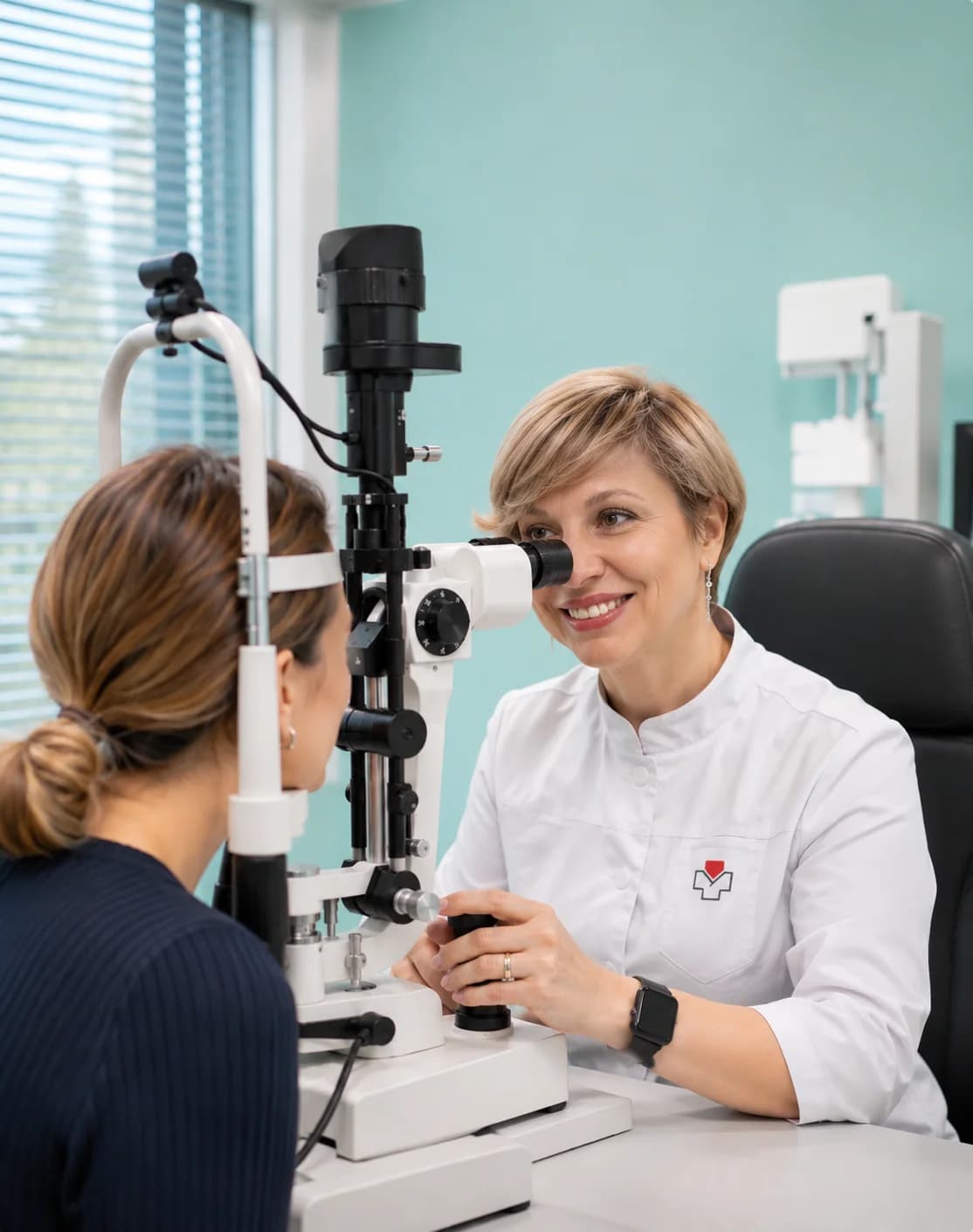
Autorefractometry requires no complex preparation and usually takes only a few minutes. Before the test, the patient removes their glasses or contact lenses and sits in front of the autorefractor. The chin is placed on a dedicated support, while the forehead rests against the instrument. This helps keep the head in the correct position for accurate measurements.
During the examination, the patient looks at an image or light target inside the device, keeping their gaze steady. The autorefractor directs a beam of light into the eye and analyses the light reflected from the retina. It then calculates the refractive measurements based on the collected data. Each eye is tested separately, usually with several readings taken to refine the result.
The procedure is non-contact and painless. The instrument does not touch the surface of the eye, and the patient may see an image that changes in focus or appearance during the measurement. Once the test is complete, the doctor reviews the numerical readings and explains what they mean. If the eye's focusing response may affect the accuracy of the result, the ophthalmologist may recommend additional testing after using eye drops that temporarily relax the focusing muscles.

Specialists

Savina Olena Mykhailivna
Pediatric ophthalmologist, Ophthalmic geneticist, Ophthalmologist

Кравчук Микола Михайлович
Ophthalmologist, Pediatric ophthalmologist
What does autorefractometry measure?
Autorefractometry helps determine how accurately the eye bends incoming light and whether images are focused on the retina. The test can identify the main types of refractive error: myopia (short-sightedness), hyperopia (long-sightedness) and astigmatism. In myopia, images focus in front of the retina, making distant objects appear blurred. In hyperopia, the focal point tends to lie behind the retina, while astigmatism occurs when light is refracted unevenly across different meridians of the eye.
For a complete assessment of vision, autorefractor readings are considered alongside visual acuity and other clinical findings. These assessments are available as part of a comprehensive ophthalmological examination.
The measurement provides several values for each eye. Sphere (SPH) indicates the degree of myopia or hyperopia, cylinder (CYL) shows the presence and degree of astigmatism, and axis (AXIS) specifies its orientation in degrees. These measurements help the ophthalmologist assess the type of refractive error and determine the next steps. However, autorefractometry does not measure visual acuity and cannot replace a vision test. To determine the appropriate correction, the doctor considers the results alongside visual acuity testing and other findings from the eye examination.
Frequently asked questions
Can I get a glasses prescription based on autorefractometry results alone?
Can children undergo autorefractometry?
Can autorefractometry be performed during pregnancy?


